
Gas Stove Burner Won’t Light but You Can Smell Gas? Stop and Do This First
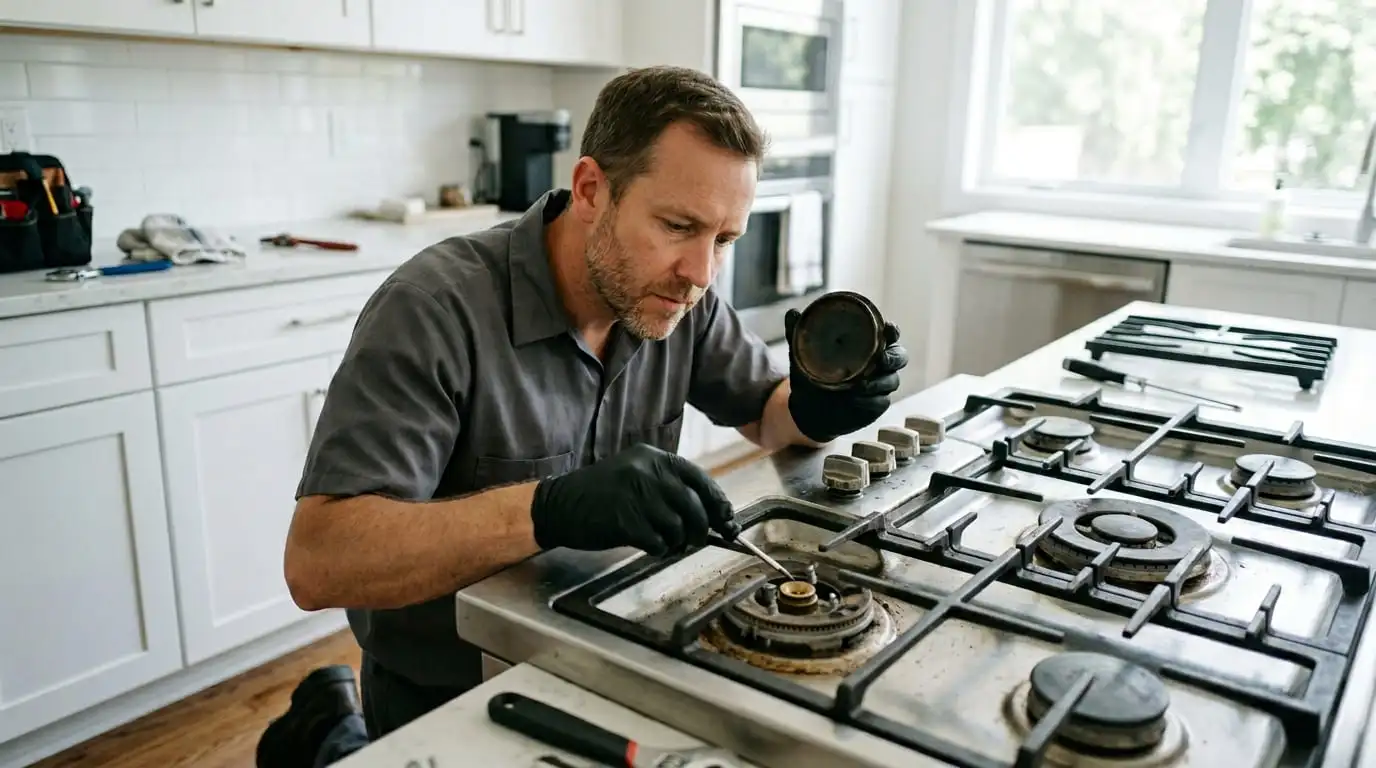
If your gas stove burner will not light but you can smell gas, stop troubleshooting for a minute. This is not the time to keep clicking the burner, light a match, or try every knob on the range.
A gas smell means fuel is being released. If the burner does not ignite quickly, that gas can build up around the cooktop, kitchen, or nearby cabinets.
Sometimes the cause is simple: a wet igniter, clogged burner port, dirty burner cap, or cap that is not sitting straight. Other times, the issue is inside the ignition system, gas valve, or control parts and needs a technician.
The first step is safety. The repair comes after the gas smell is under control.
Quick Answer:
- If your gas stove burner will not light but you can smell gas, turn all burner knobs off immediately.
- Open windows and doors to ventilate the kitchen.
- Do not light matches, use a lighter, flip light switches, or operate electrical appliances while the gas smell is present.
- If the gas odor is strong, spreading, or does not clear quickly, leave the home and call your gas utility or emergency services.
- Once the area is safe, common causes include a wet igniter, clogged burner holes, misaligned burner cap, failed spark igniter, or faulty ignition module.
- Stop First: What to Do When You Smell Gas
- Is a Small Gas Smell Normal?
- How a Gas Stove Burner Ignites
- Quick Diagnosis: What You See, Hear, and Smell
- Common Reasons a Gas Burner Clicks but Won’t Light
- How to Clean Clogged Gas Burner Holes Safely
- How to Dry a Wet Gas Stove Igniter
- How to Check Burner Cap Alignment
- Can You Light It with a Match?
- When to Call a Technician
- Gas Stove Repair in Spokane and Post Falls
- FAQ
Stop First: What to Do When You Smell Gas
If your gas stove burner will not light but you can smell gas, turn off every burner control knob right away. Open windows and doors if it is safe to do so. Do not light matches, use a lighter, flip switches, or run electrical appliances while the odor is present. If the smell is strong, leave the home and call your gas utility.
Natural gas is intentionally odorized so people can notice a leak. That rotten-egg smell is usually added for safety, not because natural gas naturally smells that way.
Do not keep turning the knob to “Lite” over and over. Each attempt can release more gas if the burner does not ignite.
| Situation | What to Do | What Not to Do |
|---|---|---|
| Brief gas smell only while lighting | Turn the knob off if the burner does not ignite quickly | Do not keep clicking for a long time |
| Gas smell lingers near the stove | Turn all knobs off and ventilate the kitchen | Do not use matches, lighters, or electrical switches |
| Strong gas smell in the room | Leave the home and call the gas utility or emergency services | Do not stay inside trying to diagnose the stove |
| Gas smell returns when the knob is used | Stop using that burner and schedule service | Do not keep cooking on a burner that fails to ignite |
Gas safety rule: If the smell is strong, spreading, or does not clear after ventilation, leave the home. A stove repair can wait. A gas leak cannot.
The CDC warns that fuel-burning appliances can create carbon monoxide risks if combustion or venting is unsafe. Gas range problems should always be treated carefully, especially when odor, flame quality, or ignition behavior changes.
Is a Small Gas Smell Normal?
A very brief gas smell can happen when you first turn a burner knob to the “Lite” position. Gas reaches the burner head a split second before ignition, so a short puff of odor may be normal.
But the smell should not be strong, continuous, or spreading through the room.
| Gas Smell | Usually Normal? | What It Means |
|---|---|---|
| Small puff right before ignition | Often normal | Gas reaches the burner just before the spark lights it |
| Gas smell while burner keeps clicking | Not normal | Gas is flowing but ignition is failing |
| Gas smell after the knob is off | Not normal | Possible leak or valve issue |
| Strong odor away from the stove | Dangerous | Leave the home and call the gas utility |
In the field, I treat repeat gas smell complaints seriously. Sometimes it is a dirty burner. Sometimes it is a failed part. The difference matters.
How a Gas Stove Burner Ignites
A gas surface burner needs two things at the same time: gas flow and ignition spark.
When you turn the control knob to “Lite,” the valve opens and gas flows through the burner base. At the same time, the ignition switch signals the spark module to send voltage to the igniter electrode. That spark jumps near the burner and lights the gas.
If gas flows but the spark is weak, blocked, wet, or in the wrong position, the burner may click but not light. That is when you smell gas.
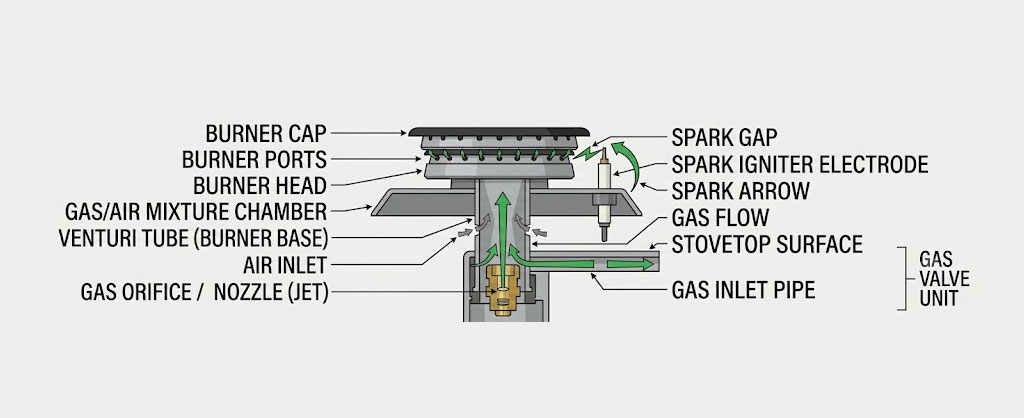
Main Parts Involved
- Burner cap: spreads flame evenly over the burner head.
- Burner base or head: directs gas through small burner ports.
- Burner ports: small holes where gas exits before ignition.
- Igniter electrode: ceramic and metal spark point near the burner.
- Ignition switch: activates spark when the knob is turned.
- Spark module: sends spark power to one or more igniters.
- Gas valve: controls gas flow to the burner.
That system is simple when everything is clean, dry, and aligned. Most no-light burner problems start when one of those conditions changes.
Quick Diagnosis: What You See, Hear, and Smell
Once the gas smell is gone and the stove area is safe, you can use the symptoms to narrow down the likely cause.
| Symptom | Possible Cause | What to Check First |
|---|---|---|
| Burner clicks but will not light | Wet igniter, clogged port, misaligned cap | Cap position, burner holes, moisture around electrode |
| Gas smell but no clicking | Failed igniter switch, spark module, wiring issue | Stop using the burner and call a technician |
| One burner will not light | Local burner issue | Cap, base, ports, igniter tip for that burner |
| All burners do not spark | Spark module or power issue | Check power only if safe; otherwise schedule service |
| Flame is yellow or uneven | Dirty port, wrong cap, poor gas-air mix | Clean and align burner parts |
| Clicking continues after cleaning | Wet igniter or stuck ignition switch | Dry the burner area fully |
Important: This diagnosis is for basic visual checks only. Do not remove sealed gas parts, test gas valves, or open the range if you smell gas or do not know what you are doing.
Common Reasons a Gas Burner Clicks but Won’t Light
When a gas stove clicks but will not light, the cause is often around the burner head, not deep inside the appliance. Start with the simple visible problems after the area is safe.
1. Clogged Burner Ports
Food, grease, cleaning residue, or boil-over liquid can block the small burner holes. Gas may still flow, but it does not reach the spark area properly. The burner clicks, gas odor appears, and the flame never catches.
2. Wet Igniter After Cleaning or a Spill
If water or cleaner gets around the spark electrode, the spark can weaken or jump in the wrong place. This is very common after deep cleaning the cooktop.
3. Misaligned Burner Cap
If the burner cap is crooked, upside down, not seated, or on the wrong burner, gas may not spread correctly. A misaligned cap can cause clicking, no ignition, uneven flame, yellow flame, or gas smell.
4. Dirty Igniter Electrode
The igniter tip needs to spark cleanly toward the burner. Grease or carbon buildup around the ceramic electrode can interfere with ignition.
5. Failed Ignition Switch or Spark Module
If there is no clicking, weak clicking, or multiple burners stop sparking at once, the problem may be electrical. That is not a cleaning issue anymore.
6. Gas Valve or Supply Problem
If gas flow seems abnormal, the flame is inconsistent, or odor continues after the knob is turned off, stop using the appliance. Gas valve and supply issues need professional service.
How to Clean Clogged Gas Burner Holes Safely
If the gas smell is gone and the burner is cool, you can clean visible burner parts. This is the homeowner-safe part of the repair.
Before cleaning: Turn all knobs off. Let the burner cool. Do not clean while you still smell gas.
Safe Burner Port Cleaning Steps
- Remove the burner grate.
- Lift off the burner cap.
- Check the burner cap and burner base for grease, crumbs, and dried spills.
- Wipe loose debris with a dry microfiber cloth.
- Use a soft toothbrush to clean around the burner head.
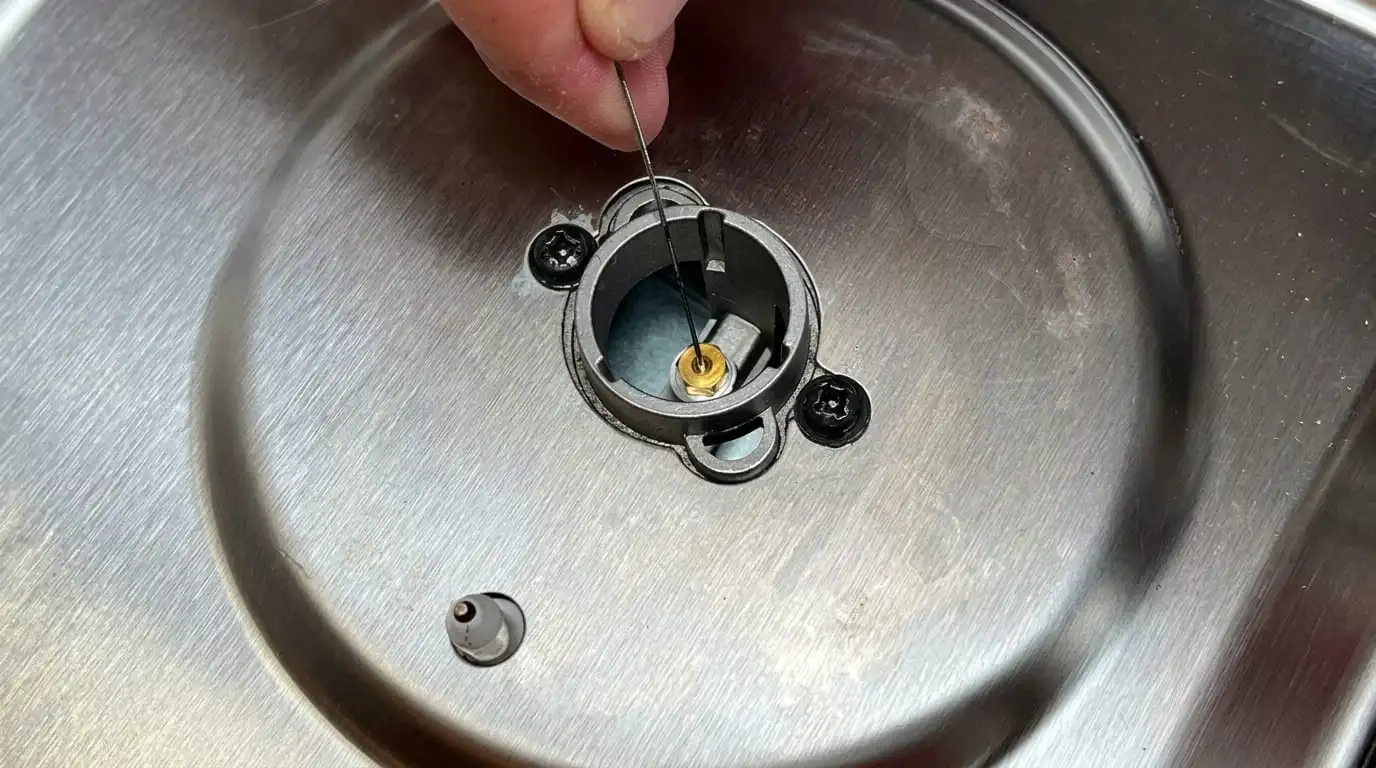
- Use a sewing needle or straight pin to gently clear clogged burner holes.
- Do not enlarge the holes or force the pin deep into the burner.
- Let all parts dry fully before reassembling.
- Place the burner cap back flat and centered.
| Use | Avoid |
|---|---|
| Sewing needle or straight pin | Wood toothpicks that can break inside the port |
| Soft toothbrush | Steel wool or harsh abrasive pads |
| Dry microfiber cloth | Soaking electrical igniter parts |
| Mild cleaner on removable parts | Spraying cleaner directly into the burner or igniter area |
Manufacturers such as Whirlpool recommend using a pin or needle for clogged burner ports and avoiding wooden picks that can break off inside the burner.
How to Dry a Wet Gas Stove Igniter
If the stove started clicking after cleaning, boiling over a pot, or wiping the cooktop with too much liquid, moisture may be the problem.
A wet igniter may click repeatedly, spark weakly, or fail to light the burner even though gas is flowing.
Safe Drying Steps
- Turn every burner knob off.
- Remove the grate and burner cap.
- Wipe around the igniter electrode with a dry microfiber cloth.
- Let the burner area air dry.
- If needed, use a hair dryer on a cool or low setting to move air across the burner area.
- Do not overheat plastic trim, knobs, or wiring areas.
- Reassemble only when everything is fully dry.
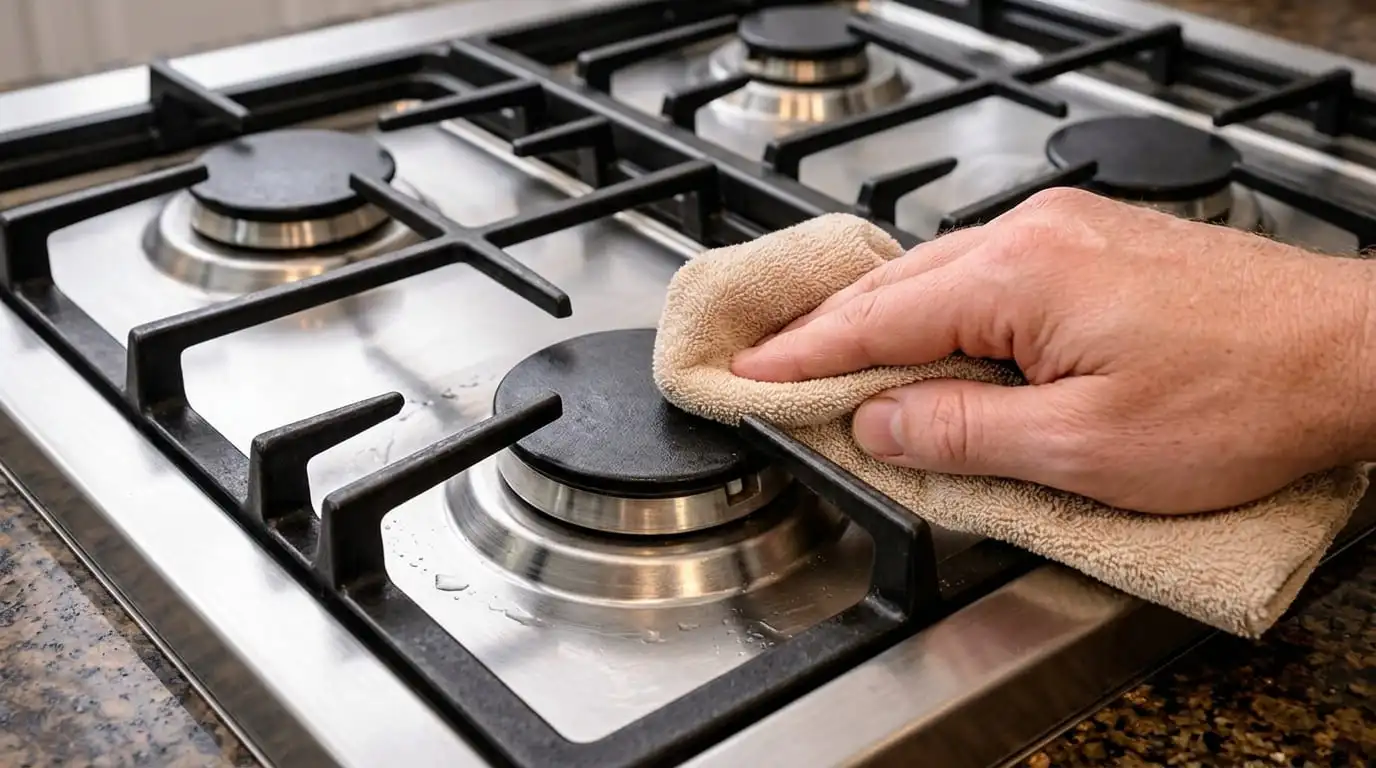
Field note: After heavy cooktop cleaning, I often see burners that click but will not light because the igniter area is still damp. Drying the electrode completely can solve the problem if no parts are damaged.
GE Appliances notes that moisture around burner components can cause continued clicking and ignition trouble until the area dries.
How to Check Burner Cap Alignment
A gas burner cap has to sit flat and centered on the burner base. If it is crooked, swapped from another burner, or not seated correctly, the flame path changes.
This can cause no ignition, delayed ignition, popping sounds, uneven flame, yellow flame, or gas smell.
How to Check It
- Make sure the burner is cool and all knobs are off.
- Remove the grate.
- Lift the burner cap and inspect it for grease or food buildup.
- Look for markings that show which burner the cap belongs to.
- Place the cap back on the matching burner base.
- Make sure it sits flat, not tilted or rocking.
- Confirm the cap is centered over the burner head.
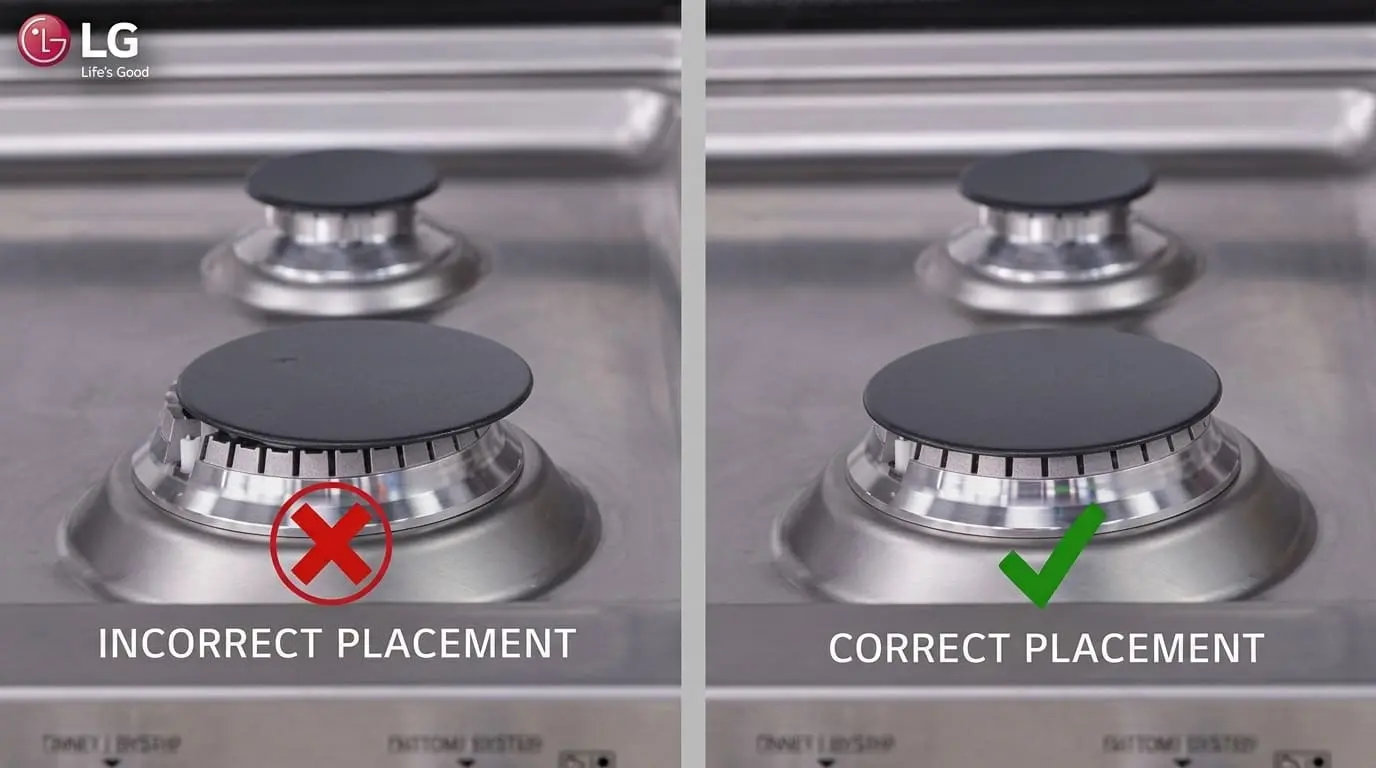
| Cap Position | Likely Result |
|---|---|
| Flat and centered | Even ignition and steady flame |
| Crooked or tilted | Clicking, delayed ignition, gas smell |
| Wrong cap size | Uneven flame or yellow flame |
| Dirty cap openings | Weak flame or no ignition |
If the cap does not sit correctly after cleaning, do not force it. Check the manual or schedule service.
Can You Light a Gas Stove with a Match If It Clicks but Won’t Light?
Do not use a match if you already smell gas.
Some older ranges may include manual lighting instructions for certain situations, but that does not mean it is safe to light a burner after gas has been released into the kitchen. If the burner has been clicking and gas odor is present, adding an open flame can be dangerous.
Do not light the burner with a match if:
- you smell gas around the stove;
- the smell is strong or spreading;
- the burner has been clicking without lighting;
- you are not sure whether gas has built up;
- the stove has a known ignition or valve problem.
Turn the knob off, ventilate the room, and wait until the smell is gone. If the odor returns when you try the burner again, stop using it and call a technician.
When to Call a Technician
Cleaning a burner cap or clearing a visible clogged port is one thing. Gas valve, ignition module, wiring, and internal range diagnosis are different.
Call a professional appliance technician if the problem goes beyond simple cleaning and drying.
| Call a Technician If | Why It Matters |
|---|---|
| Gas smell continues after the knob is off | Possible valve or leak issue |
| One burner releases gas but never lights | Ignition, burner, or gas flow problem needs diagnosis |
| No burners click | Possible spark module, switch, wiring, or power issue |
| Burner lights with a delayed “whoosh” | Gas may be accumulating before ignition |
| Flame is yellow, large, uneven, or lifting | Possible combustion or burner alignment issue |
| You hear clicking when all knobs are off | Possible stuck ignition switch or moisture/electrical problem |
| You suspect a gas leak | Stop using the appliance and contact the gas utility or qualified professional |
A technician can inspect the igniter electrode, spark module, ignition switch, burner base, gas valve behavior, and electrical circuit safely. If parts are needed, the repair should be based on diagnosis, not guessing.
My rule: If gas is involved and the symptom keeps coming back, do not keep experimenting. Get the range checked before using that burner again.
For general appointment preparation, you can also review our professional technician service checklist.
Gas Stove Repair in Spokane and Post Falls
Gas ranges are common in Spokane-area homes, and ignition problems are one of the more urgent service calls. The customer usually says the same thing: “The burner clicks, I smell gas, but it will not light.”
At IV Appliance Clinic, we service gas stoves, ranges, cooktops, and ovens in Spokane, Spokane Valley, Liberty Lake, Cheney, Airway Heights, Post Falls, and nearby areas.
We check the simple things first: burner cap alignment, clogged ports, wet igniters, and visible buildup. If the issue is deeper, we diagnose the ignition system, spark module, wiring, and gas-related components before recommending parts.
My name is on the company, and I take that seriously. If the burner only needs cleaning and alignment, we will tell you. If it is unsafe to keep using, we will tell you that too.
If your gas stove burner will not light, smells like gas, clicks without flame, or has a delayed ignition,
schedule stove and range repair service,
contact IV Appliance Clinic,
or call
+1 (253) 378-7549.
Ivan Vynychenko is the owner of IV Appliance Clinic, a licensed and insured appliance repair and installation company serving Spokane County, WA and Post Falls, ID. Ivan works directly with homeowners, landlords, property managers, and local businesses to diagnose appliance problems, complete proper repairs, and help customers make practical decisions about repair, replacement, and installation.
FAQ
Why do I smell gas but my stove won’t light?
You smell gas because the burner valve is releasing gas, but the burner is not igniting. Common causes include a wet igniter, clogged burner ports, misaligned burner cap, dirty igniter electrode, failed ignition switch, or spark module problem.
Is it normal to smell a little gas when lighting a stove?
A very brief gas smell right before ignition can be normal. A strong, continuous, or lingering gas smell is not normal. Turn the burner off, ventilate the kitchen, and stop using the stove if the odor continues.
What should I do if I smell gas in my house?
Turn off the stove knobs if safe, avoid flames and electrical switches, open windows if possible, and leave the home if the smell is strong or spreading. Call your gas utility or emergency services from outside the home.
Why is my gas stove clicking but not lighting?
A clicking burner that will not light is often caused by moisture, food debris, clogged burner holes, a dirty igniter, or a burner cap that is not seated correctly. If cleaning and drying do not help, the ignition system may need service.
How do you clean clogged gas stove burner holes?
Turn the burner off, let it cool, remove the grate and burner cap, wipe debris away, and gently clear clogged burner holes with a sewing needle or straight pin. Do not use wooden toothpicks because they can break inside the port.
Can a dirty burner cap cause gas smell?
Yes. A dirty or misaligned burner cap can prevent gas from reaching the spark area correctly. Gas may flow without lighting, creating a gas smell around the cooktop.
How do I know if my stove spark module is bad?
If no burners click, multiple burners stop sparking, or the clicking is weak or inconsistent, the spark module or ignition switches may be faulty. These parts should be tested and replaced by a technician.
Can you light a gas stove with a match if it clicks but won’t light?
Do not use a match if you smell gas. Turn the knob off, ventilate the area, and wait until the odor is gone. If the smell returns or the burner still will not light, stop using it and call a technician.
How long does it take for gas smell to dissipate?
A minor gas odor may clear within several minutes with good ventilation. If the smell remains strong, spreads through the home, or returns after the burner is off, leave the home and call the gas utility.
How do you dry a wet gas stove igniter?
Turn all knobs off, remove the grate and burner cap, wipe the igniter area with a dry microfiber cloth, and let it air dry. A hair dryer on a cool or low setting can help move air across the area.
When should I call a technician for a gas stove?
Call a technician if gas smell continues, the burner has delayed ignition, there is no clicking, multiple burners fail, the flame is yellow or uneven, or the problem returns after cleaning and drying.